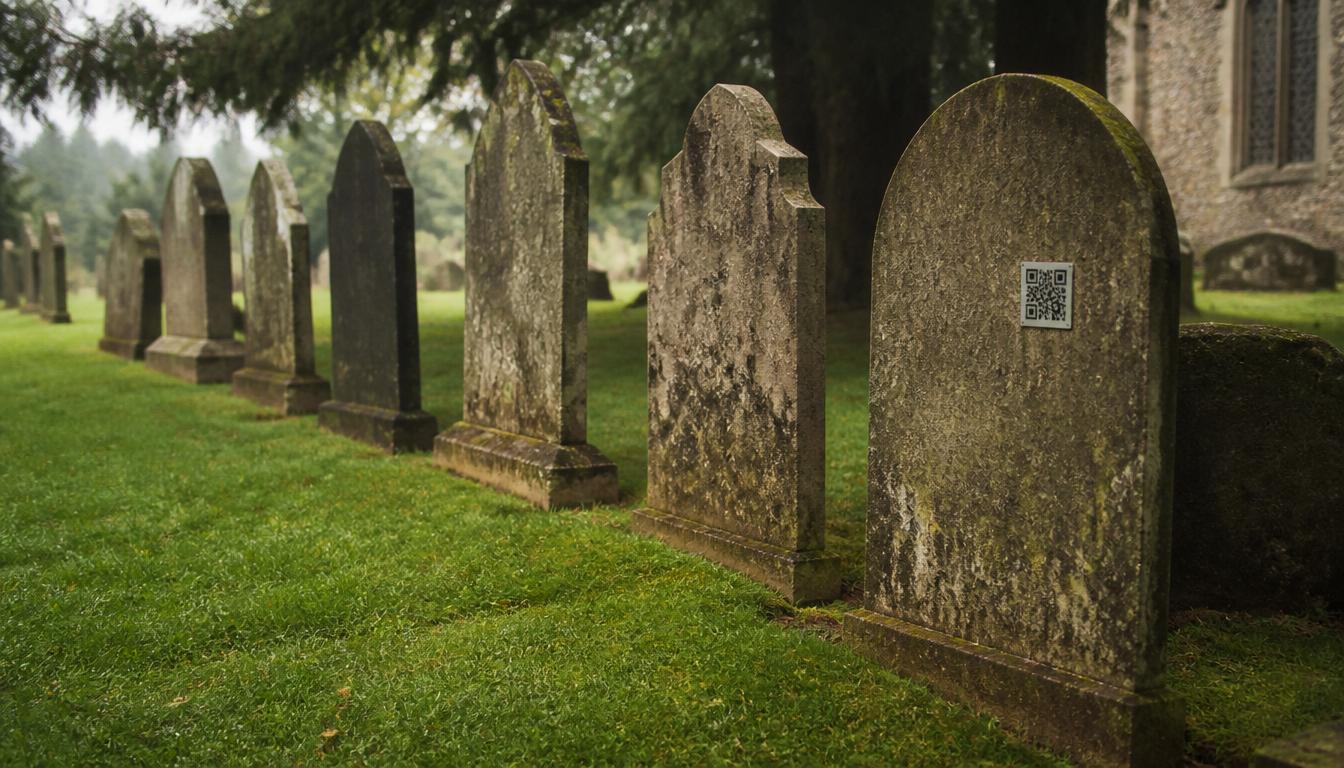
QR Codes on Gravestones UK: How They Work
QR codes on gravestones are appearing in cemeteries and churchyards across the UK — from large municipal grounds to small village burial sites. If you've spotted a small square code on a headstone and wondered what it does, or you're considering one for a family grave, this guide explains how they work in a specifically British context: the rules, the practicalities, and the costs.
What a QR code on a gravestone does
Scan the code with any phone camera and it opens an online memorial page for the person buried there. Instead of a few engraved lines, visitors reach a full digital tribute — photographs, the life story, video clips, and a guestbook for messages.
For UK families, this has particular appeal. Many have relatives who have moved abroad or across the country, and a scannable memorial lets everyone stay connected to the graveside without needing to travel.
Are QR codes allowed on gravestones in the UK?
In most cases, yes — but permission depends on where the grave is.
- Council-run cemeteries usually have memorial regulations covering size, materials, and fixtures. A small, discreet QR plaque is typically permitted, but you should check with the cemetery office first.
- Church of England churchyards are governed by the local diocese and often the faculty system. Additions to a memorial may need approval from the parish or the diocesan authorities, so ask the incumbent before fixing anything.
- Private and natural burial grounds set their own rules, which are often more flexible.
How the technology works
There are three simple components:
- A memorial page with a permanent web address.
- A QR code that encodes that address.
- A plaque or engraving that carries the code on the stone.
Fixing a QR code to a headstone
You have two practical options in the UK:
- A QR memorial plaque — a small engraved metal or ceramic plate fixed with outdoor-grade adhesive or discreet screws. This is the most popular choice: affordable, reversible, and doesn't require a stonemason.
- Direct engraving — a monumental mason etches the code into the stone, usually alongside other lettering. This is permanent and blends in, but costs more and needs professional work.
What it costs in the UK
- The memorial page: free to create with Vidalem, including unlimited photos and stories.
- The physical plaque: a modest one-off cost (from around €9.99). Vidalem's QR memorial plaques are laser-engraved on weatherproof material built for the UK climate and arrive pre-linked to your memorial, so there's nothing technical to configure.
Privacy: who can see the memorial?
A common UK concern is whether scanning the code exposes personal information. With a well-designed platform you stay in control:
- You choose whether the memorial is fully public, unlisted, or private.
- You decide who can post messages or add photos.
- Sensitive details can be left off entirely.
Step by step for a UK grave
Step 1: Check permissions
Confirm with the cemetery office or parish that a small QR plaque is allowed.
Step 2: Create the memorial page
Add photos, dates and the life story.
Step 3: Order a weatherproof QR plaque
Choose a plaque linked to that page.
Step 4: Fix the plaque
Attach it to the stone once you have approval.
Step 5: Share the link
Send it to relatives so family abroad can visit online too.
The bigger picture
QR codes on gravestones are becoming a normal part of British remembrance because they solve a modern problem: families are more scattered than ever, and a stone alone can't hold a whole life. Used respectfully — and with the right permissions — a small code turns a headstone into a doorway to a memorial that the whole family can share, wherever they are.
You can start for free with Vidalem and order a UK-ready QR plaque whenever you're ready.